
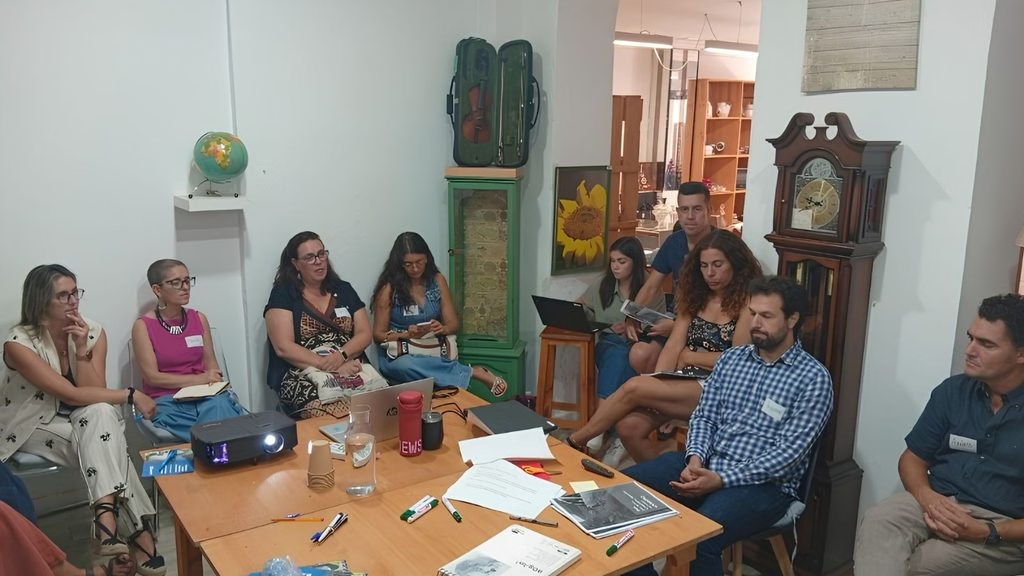
Representatives of agricultural businesses and social organisations in Huelva have taken part in two working sessions to explore how the LANAGRO model could be adapted to the region. The initiative is one of the projects supported by ASETT’s Social Laboratory, which aims to promote innovative solutions to social and economic challenges and facilitate their transfer to other contexts.
Is it possible to transform seasonal agricultural work into a more stable, professionalised and sustainable employment model? How can the needs of agricultural businesses be aligned with better working conditions and greater inclusion opportunities for workers?
These were among the questions addressed in Huelva during the working sessions held on 10 September, organised by Red Lantierra and Oxfam Intermón, with the participation of representatives from agricultural businesses and various social organisations in the region.
The aim of the meetings was to explore the possibilities of adapting the LANAGRO model to Huelva. Developed in Álava, the initiative offers an alternative to traditional seasonal agricultural employment by combining decent work, professionalisation, continuous training and the social and labour market integration of people in vulnerable situations.
Listening to the region to adapt the model
The event was structured around two complementary working sessions.
The first brought together representatives of agricultural businesses and sector organisations to analyse recruitment needs, the challenges of managing seasonal employment and the conditions required to make a model such as LANAGRO viable in Huelva.
Key issues included the differences in scale between agricultural activity in Álava and Huelva, the need for a sufficient volume of work, and the possibility of combining different agricultural campaigns with other activities to provide greater employment continuity.
The second session brought together social organisations from the region to explore their interest in the model, its potential implementation and the collaboration and governance arrangements needed to move it forward.
Participating organisations recognised LANAGRO’s potential to address social and labour market inclusion needs and improve agricultural employment, while also identifying challenges relating to economic sustainability, funding and the development of partnerships.
The sessions helped identify opportunities, as well as issues that must be addressed before moving towards the potential implementation of the model in Huelva.
The next steps proposed include identifying organisations interested in leading the initiative, engaging with public authorities and universities, and analysing its legal structure and economic viability.
LANAGRO: A project supported by ASETT’s Social Laboratory
LANAGRO is one of the projects supported by ASETT’s Social Laboratory, a space dedicated to promoting initiatives that offer practical responses to major social and economic challenges.
The project was selected for its potential to address a structural challenge: moving away from agricultural employment characterised by seasonality towards more stable, professionalised and sustainable forms of work, combining social and labour market inclusion with improvements in the sector’s productivity.
ASETT’s support focuses particularly on connecting stakeholders, generating applied knowledge, systematising lessons learned and identifying opportunities for replication across different regions.
The experience in Huelva illustrates one of the key challenges addressed by the Social Laboratory: understanding which elements of an initiative that works in one region can be transferred to another, what adaptations are required, and which partnerships are needed to make the process viable.
The aim is not to replicate solutions automatically, but to learn from existing experience, test it against new realities and help develop models that can become established and generate impact in other regions.
The experience in Huelva reflects the purpose of ASETT’s Social Laboratory: connecting initiatives that are already addressing real-world challenges with new regions and stakeholders, generating knowledge from practical experience, and enabling solutions to be adapted, consolidated and scaled up to achieve a greater impact.
Because transforming our economy and society does not always mean starting from scratch. It also means learning from what already works and creating the conditions for those solutions to reach further.