
Catalonia has reinforced its position as an international hub for rethinking the role of business in a time of profound economic, social and technological transformation.
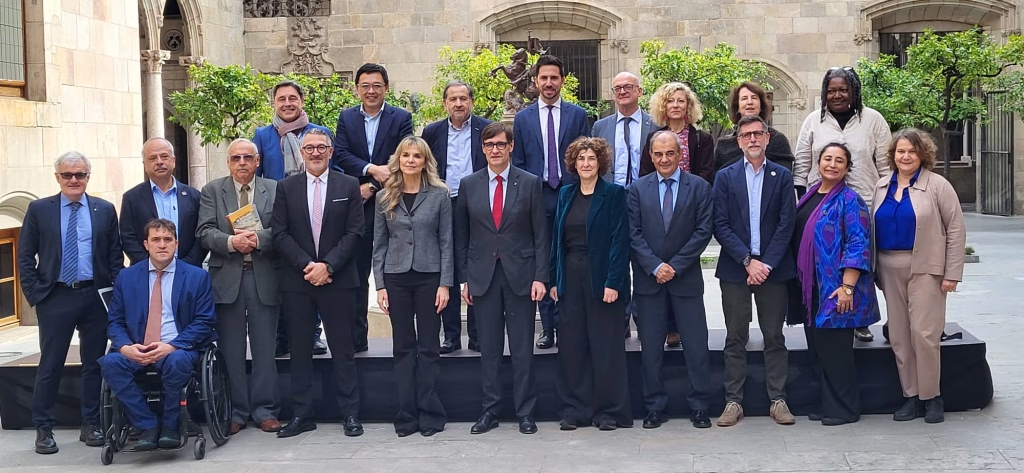
Barcelona hosted the meeting of the International Advisory Board of ASETT (Arizmendiarrieta Social Economy Think and Do Tank), bringing together leading experts from multilateral organisations, European institutions and governments—including the International Labour Organization (ILO), the United Nations, the European Commission, the OECD, and the Government of Mexico—to advance a global conversation on the role of business in the economy of the future.
Over three days of discussions, the Board explored key issues including reducing inequalities, the future of business models, and the role of enterprises in building more inclusive, sustainable and competitive economies.
Institutional Reception at the Palau de la Generalitat
One of the highlights of the meeting was the official reception at the Palau de la Generalitat, hosted by the President of the Government of Catalonia, Salvador Illa Roca, who welcomed the Board members and emphasised the need to move towards more inclusive economic models.
“It is positive for companies to increase their profits, but that prosperity must be shared. The Social Economy embodies this principle exceptionally well.”
During the reception, institutional representatives highlighted the Social Economy as a business model capable of combining economic competitiveness, innovation and social cohesion.
Elena Pérez, Deputy Minister of Labour and Social Security of the Basque Government and President of ASETT, stated:
“The Social Economy demonstrates to the world that another way of doing business is possible—one built on collaboration, shared value and democracy.”
Meanwhile, Amparo Merino, Spain’s Secretary of State for the Social Economy, reaffirmed the Spanish Government’s commitment to the sector and highlighted ASETT as a clear expression of that commitment.
Strategic Dialogue Connected to Real-World Experience
The programme combined high-level strategic discussions with first-hand exposure to successful examples from Catalonia’s Social Economy ecosystem.
The meetings began at Bloc4BCN – Espai Cooperatiu, where participants were welcomed by Laia Bonastra, President of the Federació de Cooperatives de Treball de Catalunya. The Board also met at Barcelona Circular (BAC), a space that demonstrates how economic transformation is being driven through practical, collaborative initiatives.
A central theme throughout the discussions was the role that businesses can—and should—play in reducing inequalities.
The programme also included visits to organisations such as Sostre Cívic, Fundació Hàbitat3, Grup Cooperatiu TEB, and FedeFARMA, showcasing how the Social Economy is already delivering tangible solutions in areas including affordable housing, labour market inclusion and regional development.
Looking Ahead to the ASETT Forum 2026
The meeting also advanced ASETT’s international agenda. During the discussions, it was announced that Brazil will be the guest country at the ASETT Forum 2026, strengthening dialogue between Europe and Latin America on new models of economic development.
The ASETT Forum continues to establish itself as a leading international platform, bringing together policymakers, business leaders and academics to explore the role of the Social Economy in shaping the future of economic systems.
ASETT: A Platform for Thought and Action
The International Advisory Board meeting further reinforces ASETT’s role as an international platform for dialogue and action, connecting knowledge, public policy and business practice to promote economic models that are fairer, more inclusive and more sustainable.
ASETT (Arizmendiarrieta Social Economy Think and Do Tank) is an international initiative established through a public-private partnership that brings together businesses, public institutions and academia to strengthen the Social Economy as a driver of transformation.
It serves as a platform for knowledge generation, collaboration and experimentation—conducting research, building strategic partnerships and launching initiatives capable of reducing inequalities and creating meaningful impact across communities.