
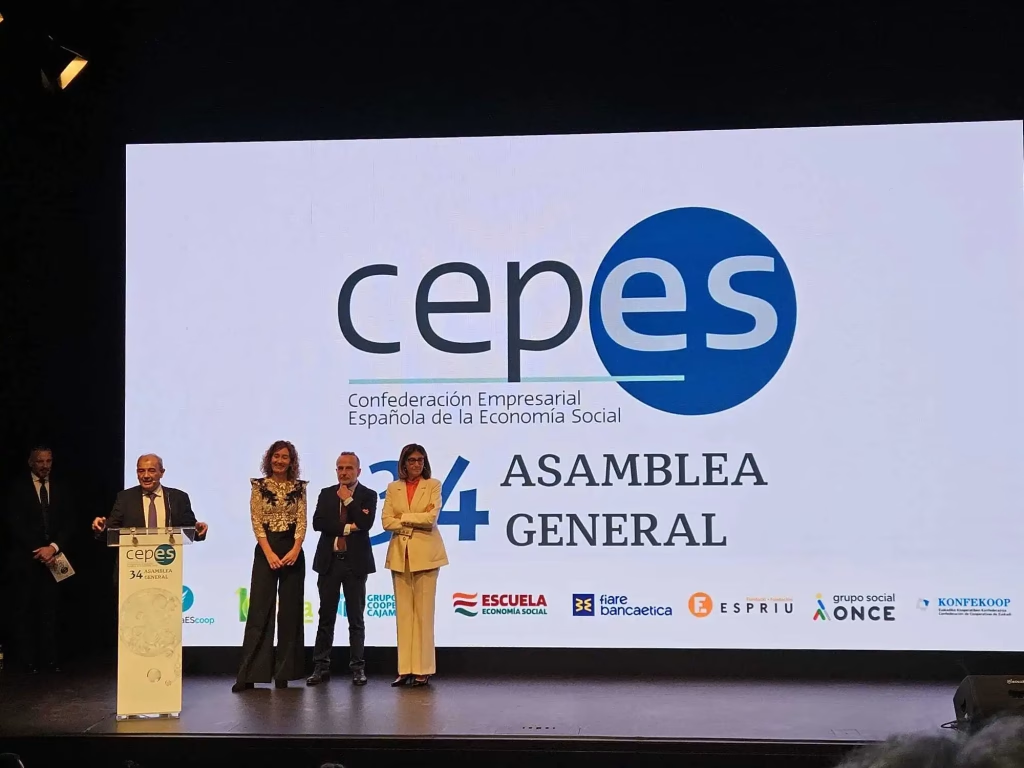
The Social Economy Strengthens Its Strategic Role at the CEPES General Assembly
ASETT took part in the 34th CEPES General Assembly, held in Málaga, an event that once again highlighted the growing importance of the Social Economy within Spain’s productive model.
According to Spain’s National Statistics Institute (INE), the Social Economy now accounts for 11.1% of the country’s GDP, underlining both its economic significance and its social contribution.
The Assembly brought together more than 170 participants, including business organisations, public institutions, trade unions and representatives of civil society, reflecting the sector’s growing institutional recognition.
A Sector with Greater Influence—and Greater Responsibility
CEPES President Juan Antonio Pedreño highlighted the sector’s evolution:
“One of the Social Economy’s greatest strengths lies in its unity. Today, we are a business sector with greater capacity to influence and lead real economic and social transformation.”
Pedreño also emphasised that the Social Economy has evolved beyond being simply a mechanism for responding to crises and has become a strategic instrument of economic and industrial policy, encompassing more than 127,000 enterprises and supporting almost 2.3 million jobs.
Institutional Framework and International Outlook
Amparo Merino, Spain’s Secretary of State for the Social Economy, highlighted the importance of the new legislative framework recently adopted:
“Spain is now a global leader in the Social Economy. This leadership brings significant responsibility, but also an opportunity to open new markets and expand the impact of these enterprises.”
Meanwhile, Rocío Blanco, Regional Minister for the Government of Andalusia, underlined the Social Economy’s structural importance within the region’s economy.
Key Challenges: Competitiveness, Scale and Talent
The Assembly also addressed the sector’s main priorities in today’s economic landscape, including:
- strengthening competitiveness;
- attracting young talent;
- scaling business models; and
- reinforcing the Social Economy’s presence in key decision-making forums.
In this context, CEPES identified its positioning within the next European Union Multiannual Financial Framework (2028–2034), as well as key instruments such as the European Social Fund, as strategic priorities for the years ahead.
ASETT: Connecting, Activating and Scaling
ASETT actively participated in the working sessions held at the School of the Social Economy, contributing to dialogue across the sector and supporting initiatives aimed at strengthening the Social Economy ecosystem.
In an increasingly demanding environment, the challenge is no longer simply to consolidate the recognition the Social Economy has achieved, but to translate that recognition into greater impact, scale and influence.