
The Social Economy represents one of the most mature and well-established models of economic transformation, bringing together competitive businesses that embed social purpose into their ownership, governance, decision-making and the distribution of value.
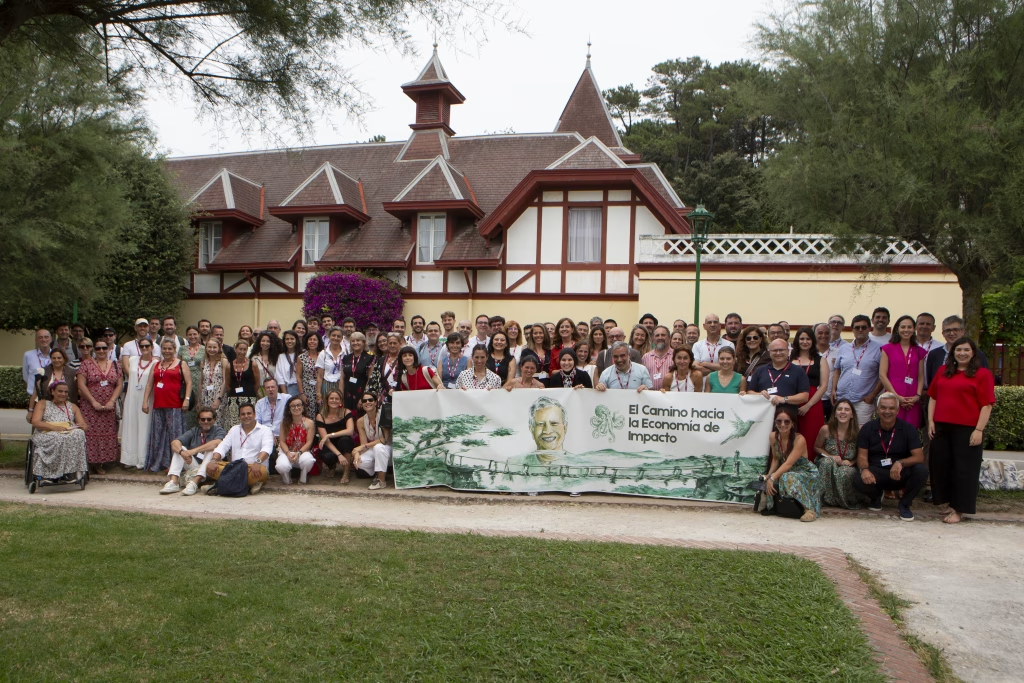
This was one of the key messages shared by ASETT during the 5th Path Towards the Impact Economy, organised by the Yunus Centre Cantabria and the University of Cantabria as part of the Summer Courses of the Menéndez Pelayo International University.
Sara Simón Penas, ASETT’s Director of Operations and Strategic Partnerships, took part in a panel discussion alongside Carlos Lozano of the Spanish Business Confederation of the Social Economy (CEPES), María Molina Martín of SpainNAB, and Luis Jiménez of the Ministry of Labour and Social Economy.
The discussion explored the relationship between the Social Economy and the impact movement, as well as opportunities for collaboration to promote business models that are more democratic, inclusive and focused on the wellbeing of people and communities.
A Well-Established Model of Economic Transformation
Social Economy enterprises operate across a wide range of sectors and contexts. Although they vary in size, structure and field of activity, they share a common approach to business that places people and social purpose at the heart of their operations.
During the discussion, participants highlighted that the Social Economy has spent decades demonstrating that it is possible to compete successfully in the marketplace while creating quality employment, fostering inclusion and social cohesion, distributing value more fairly, and building organisations with more democratic governance models.
Its distinctive feature is not simply that it delivers positive social impact. Rather, social purpose is embedded within the very structure of these businesses, shaping their ownership, decision-making processes, governance, and the way value is created and distributed.
Building on Existing Experience
Another key theme of the discussion was the relationship between the Social Economy and the impact economy along with the impact investing movement.
Over several decades, the Social Economy has developed a broad institutional, legal and business infrastructure. Cooperatives, employee-owned companies, work integration social enterprises, social initiative special employment centres, mutual societies and other business models all provide practical examples of how social purpose can be structurally integrated into economic activity.
In this context, the impact movement has an opportunity to build on this existing infrastructure, help expand and modernise it, and support its adoption across new sectors, businesses and regions.
Rather than creating parallel models, the objective is to connect existing experiences, share knowledge and strengthen the tools that already enable businesses to pursue the common good in a sustainable and lasting way.
New Challenges for the Social Economy
The Social Economy continues to evolve in response to the changes transforming the economy and the world of work.
Among its main challenges are supporting new forms of entrepreneurship, developing technology companies with more democratic ownership and governance models, advancing the green transition, embracing digitalisation, and improving access to financial instruments tailored to the specific characteristics of Social Economy organisations.
Impact investing can also play an important role in this process, provided it recognises the distinctive features of Social Economy enterprises and develops financial tools that are aligned with their ownership structures, governance models and approach to value distribution.
Such collaboration can help strengthen, consolidate and scale businesses that are already providing structural solutions to challenges such as inequality, social exclusion, depopulation and the lack of economic opportunities in certain regions.
A Different Way of Doing Business
ASETT works to strengthen and expand business models that generate economic value while making a lasting contribution to reducing inequalities and improving the wellbeing of people and communities.
The organisation was created through a public-private partnership promoted by the Government of Spain, through the Ministry of Labour and Social Economy; the Basque Government; MONDRAGON Corporation; the Provincial Council of Gipuzkoa; Donostia-San Sebastián City Council; KONFEKOOP, the Confederation of Cooperatives of the Basque Country; and GUREAK.
Participation in the 5th Path Towards the Impact Economy provided another opportunity to build bridges between the Social Economy and the diverse organisations that make up the impact ecosystem.
The shared goal is to move towards an economy in which a different way of doing business is no longer the exception, but becomes an integral part of how the economy functions.