
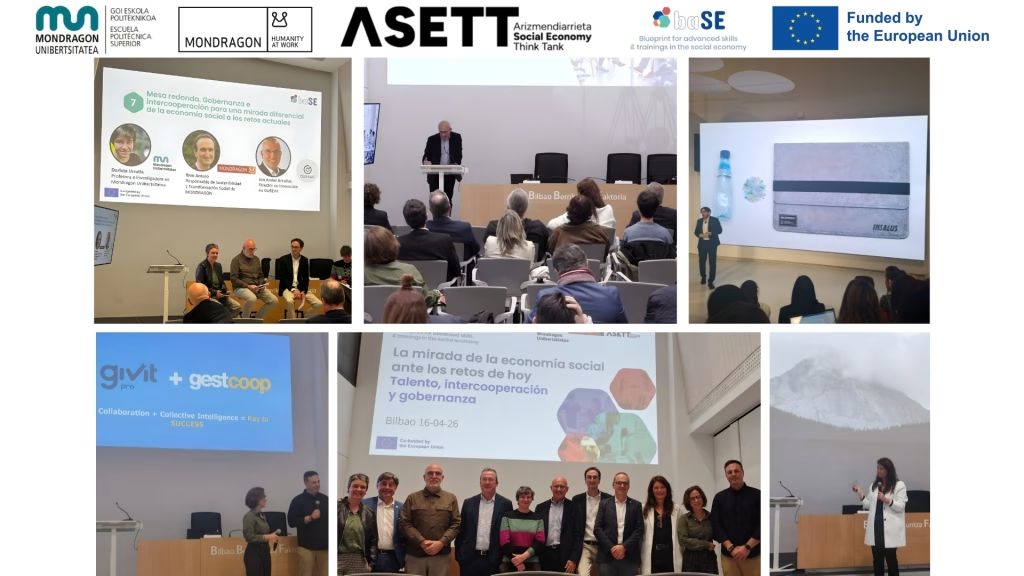
Bilbao Berrikuntza Faktoria hosted the event “The Social Economy’s Perspective on Today’s Challenges: Talent, Intercooperation and Governance,” a forum dedicated to examining how this economic model is responding to the major challenges of our time.
Representatives from public institutions, academia and a range of social economy organisations reflected on the capabilities that social economy entities already possess, as well as those they need to develop, in key areas such as digital transformation, the green transition and social inclusion.
These issues have been at the heart of the European baSE project, which aims to identify and develop a set of key competencies within social economy organisations to help them navigate the three major transitions of our time:
- the ecological or green transition
- the digital transition
- the social transition
Elena Pérez Barredo, Vice Minister for Employment of the Basque Government, kicked off the event by highlighting the sector’s importance in building a fairer and more sustainable economy. Ane Sánchez-Zeziaga, Professor at Mondragon Unibertsitatea, then presented the challenges and skills needs facing the social economy, placing particular emphasis on the importance of lifelong learning.
One of the highlights of the event was Gianluca Salvatori’s intervention, Secretary General of Euricse, who stressed the need to strengthen workers’ competencies in order to successfully navigate Europe’s three major transitions.
The event also showcased practical examples from Givit Delivery Coop, Ondoan S. Coop and Fundación Ausolan, illustrating how the social economy is creating tangible impact in areas such as sustainable logistics, training for the green transition and the management of diverse talent.
The roundtable discussion, moderated by Saioa Arando, Academic Coordinator of ASETT, focused on governance and intercooperation, emphasising the importance of collaboration between organisations as a key factor in addressing today’s challenges.
The event concluded with remarks from Iñigo Albizuri, who argued that “the social economy is not a model from the past trying to adapt to the present, but the one that best anticipates the future.” In his speech, he described intercooperation as “a competency that multiplies all the others” and highlighted that this model makes it possible “to have the scale of a giant while retaining the soul of a community-based organisation.”
He also underlined that initiatives such as ASETT (Arizmendiarrieta Social Economy Think Tank) aim to act as catalysts for change by connecting academia and the business world to ultimately develop governance models that are more sustainable, competitive and inclusive.
The event concluded with a call to continue strengthening collaboration across the sector and to harness existing talent to demonstrate that economic efficiency and social justice can move forward in tandem.