
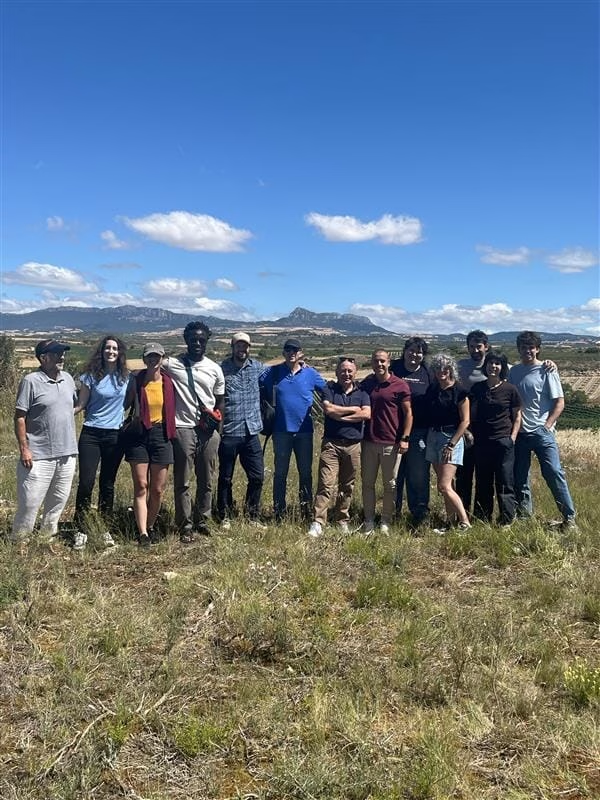
ASETT’s Social Lab is working alongside LANAGRO to analyse, systematise and support the adaptation of a model that demonstrates how agricultural employment can become more stable, professional and inclusive across different regions.
As part of this collaboration, the two organisations held a working session in Moreda de Álava, bringing together representatives from organisations and institutions across the Basque Country, Navarre, Aragon and Andalusia. Participating organisations included Intermón Oxfam, Fundación Rey Ardid, Fundación Emplea, Fundación Iturriaga Danobeitia and the Town Council of San Martín de Unx, as well as professionals specialising in the social economy, social inclusion and employment.
The event provided participants with first-hand insight into the model developed by LANAGRO, which is based on planning agricultural campaigns, providing stable employment, delivering continuous training, professionalising agricultural work and offering ongoing support to workers.
This approach helps improve working conditions, provides greater stability for farms and agricultural businesses, and facilitates access to employment for people who face greater barriers to entering the labour market. At the same time, it addresses some of the primary sector’s most pressing challenges, including shortages of skilled labour, seasonal employment, job insecurity and the lack of generational renewal.
From a Successful Initiative to a Replicable Model
The objective of the event went beyond presenting a successful experience. Participating organisations analysed the factors that have enabled the LANAGRO model to become established and shared the challenges they face in their own regions.
The meeting also explored how this experience could be adapted to different contexts, taking into account the characteristics of local production systems, the needs of farms and agricultural businesses, and the social and labour market realities of each territory.
Replicating a successful model does not mean simply copying it. It means understanding why it works, identifying its essential components and supporting its adaptation to new contexts. Achieving this requires close collaboration between social organisations, public authorities, businesses, farms and agricultural enterprises, and social economy stakeholders.
Turning Real-World Experience into Practical Knowledge
This process reflects the mission of ASETT’s Social Lab: to identify initiatives with proven impact, analyse the factors behind their success and transform accumulated experience into practical knowledge that can benefit other organisations and regions.
Through the Social Lab, ASETT creates opportunities for shared learning, fosters strategic partnerships, and supports the adaptation and scaling of solutions that are already delivering tangible responses to social and economic challenges.
LANAGRO is a clear example of how the Social Economy can help transform employment in the primary sector by balancing the needs of farms and agricultural businesses with the creation of more stable, professional and inclusive employment opportunities.
This captures the essential role of ASETT’s Social Lab: to transform real-world experience into practical knowledge and help ensure that the solutions that work can reach further.
Do you know of an initiative with the potential to transform its sector and be replicated elsewhere? We’d love to hear about it.