
The initiative aims to strengthen the role of local governments in developing public policies that promote the Social Economy and to foster the exchange of experiences between territories.
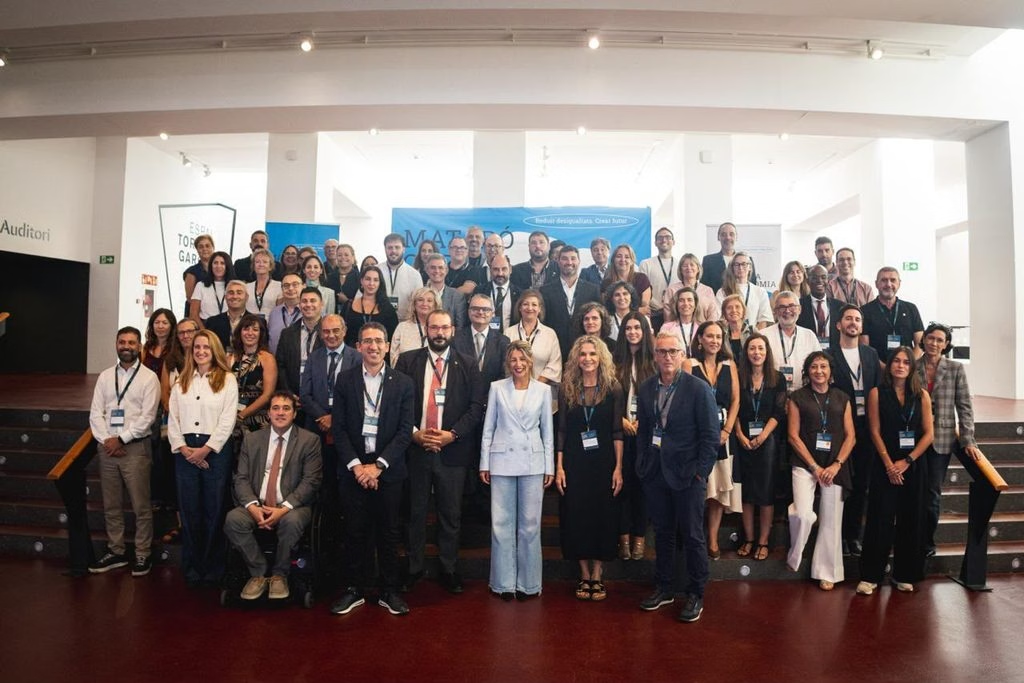
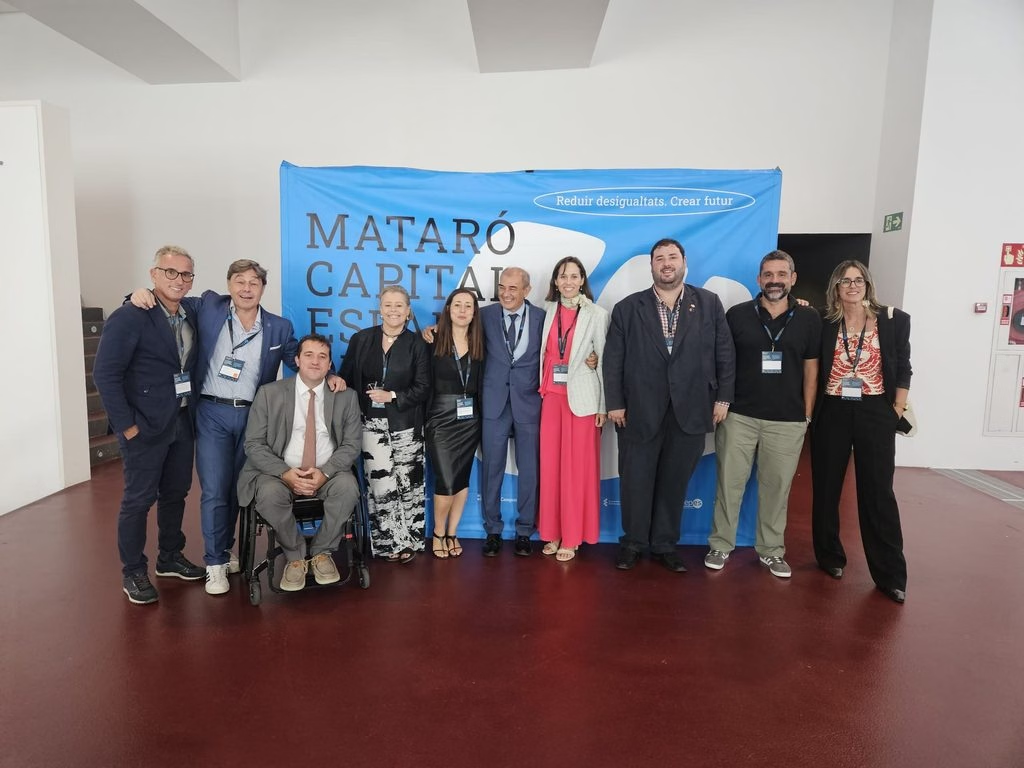
ASETT participated in Mataró in the presentation of the Network of Municipalities for the Social Economy, held at TecnoCampus Mataró-Maresme as part of Mataró’s programme as Spanish Capital of the Social Economy 2026.
The event brought together representatives of public administrations, municipalities and Social Economy organisations with the aim of strengthening collaboration between territories and advancing the role that local governments can play in building more sustainable, inclusive and cohesive models of economic development.
The event was attended by the Xarxa de Municipis per l’Economia Social i Solidària de Catalunya (XMESS), the equivalent network in the Valencian Community, the Spanish Federation of Municipalities and Provinces (FEMP), the Spanish Business Confederation of the Social Economy (CEPES), and representatives from various municipalities. The session was moderated by the Secretary of State for the Social Economy, Amparo Merino.
The programme also included a dedicated space for the exchange of experiences between municipalities, structured around three areas: Social Economy strategies and public policies; public financing instruments; and the use of public assets to support Social Economy organisations.
Territories as spaces for turning challenges into solutions
ASETT’s participation in this event is part of one of the key areas running through its work: connecting major economic and social challenges with experiences and solutions that can be developed at the local and territorial level.
Municipalities are a particularly relevant space for this transformation. It is at the local level that challenges such as care, housing, employment, inequality, economic transition and territorial cohesion take on a concrete dimension, and where new responses can be developed through collaboration between public administrations, businesses and Social Economy organisations.
This approach is also closely linked to the work of ASETT’s Social Lab, which focuses on identifying experiences, connecting stakeholders and territories, generating shared learning, and helping solutions that demonstrate results to be adapted, replicated or scaled.
The creation of stable spaces for collaboration between municipalities also helps prevent transformative experiences from remaining isolated, facilitating the transfer of knowledge and the development of public policies based on lessons already learned in other territories.
The event in Mataró therefore represents a new opportunity to strengthen these connections and advance towards a Social Economy capable of transforming major global challenges into concrete responses at the territorial level.
As a Think+DO Tank at the service of the Social Economy, we will continue working with the ecosystem to connect knowledge, experiences and territories, and to collectively move from debate to solutions.