
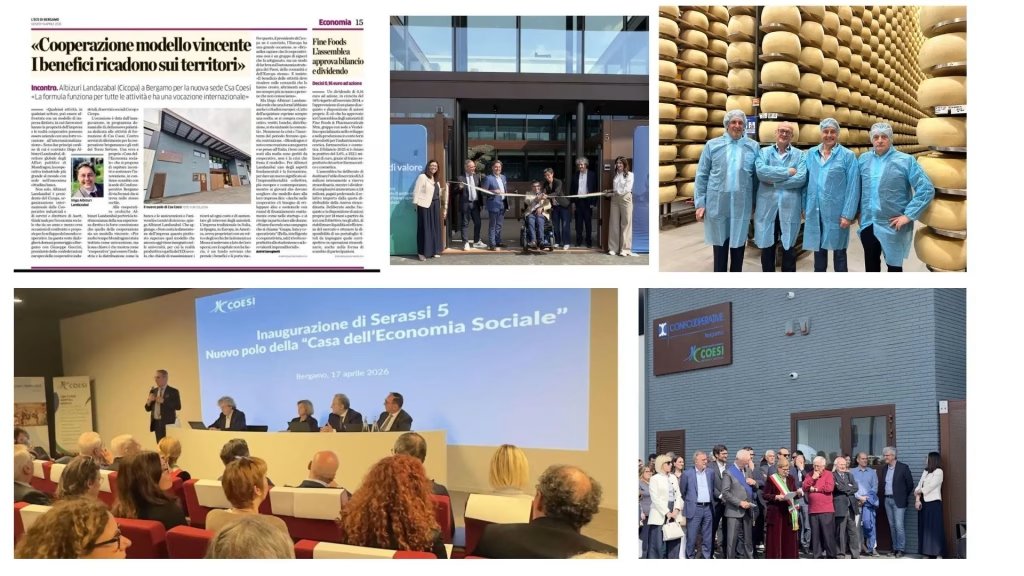
ASETT’s General Director, Iñigo Albizuri Landazabal, took part in the inauguration of the new “Serassi 5” building in Bergamo, Italy, a landmark facility designed to serve as a hub for the Social Economy and the Third Sector across the region.
The new building is part of a project led by CSA Coesi and Confcooperative Bergamo, expanding the House of the Social Economy into a centre of more than 2,700 square metres dedicated to strengthening services, training and the development of new cooperative initiatives.
Equipped with auditoriums, training rooms, collaborative workspaces and open community areas, the complex has been designed with a strong focus on environmental sustainability. It incorporates photovoltaic panels and energy-efficient climate control systems, enabling more than half of its energy needs to be met through on-site renewable generation.
The inauguration was attended by representatives from Italian public institutions and the cooperative movement, including Elena Carnevali, Mayor of Bergamo; Gianfranco Gafforelli, President of the Province of Bergamo; and Giovanni Zambonelli, President of the Bergamo Chamber of Commerce.
A European Dialogue on the Future of the Social Economy
During the event, Iñigo Albizuri Landazabal joined Giuseppe Guerini, President of Cooperatives Europe, for a discussion on the strategic role of cooperatives in Europe’s economic development.
Drawing on the experience of the MONDRAGON Corporation, one of the world’s largest industrial cooperative groups, Albizuri highlighted the cooperative model’s ability to generate economic and social value simultaneously.
In his remarks, he also presented ASETT’s role as an international centre for research, dialogue and action, dedicated to strengthening the contribution of business to reducing inequalities and building more resilient economies.
“The experience of MONDRAGON demonstrates that any sector can be organised as a cooperative. It is not a question of size, but of approach. The cooperative model generates benefits not only for those who work within the enterprise, but also for the communities around them,” said Iñigo Albizuri.
He also stressed the importance of recognising cooperatives as a strategic instrument for Europe’s economic and social autonomy, highlighting the contribution cooperative enterprises can make in responding to today’s global challenges.
Building Infrastructure for a Stronger Cooperative Ecosystem
The new Serassi 5 hub represents an important milestone in strengthening the infrastructure that supports the Social Economy, bringing together representation, services and the development of new cooperative initiatives under one roof.
Event organisers also highlighted that closer collaboration between organisations such as CSA Coesi and ASETT will strengthen links between local ecosystems and international networks for social and cooperative innovation.
The event further reinforces ASETT’s position as an international platform for dialogue and action in the Social Economy, connecting regions, knowledge and practical experience to promote more inclusive and sustainable business models.